Why Most Young Athletes Don’t Need More Sport-Specific Training,Yet!
When parents look for extra training for their child, they often ask:
“Will the program be specific to their sport?”
It is a reasonable question. A footballer needs to improve at football. A rugby league player needs to prepare for rugby league. A basketballer needs to jump, accelerate and change direction.
But for many young athletes, the answer is not more sport-specific drills.
What they often need first is to become a better all-round athlete.
That means developing the physical qualities that support almost every sport: strength, speed, power, coordination, movement competency and the ability to absorb force safely.
Sport practice is already sport-specific
A young footballer becomes better at passing, shooting and decision-making by practising football.
A baseball athlete improves hitting, throwing and fielding through baseball training.
The role of strength and conditioning is different.
The gym should not try to recreate the sport. It should build the physical qualities that help the athlete perform their sporting skills more effectively.
For example:
• Sprint training can improve acceleration.
• Strength training can increase force production.
• Jump and landing exercises can improve power and body control.
• Deceleration training can help athletes stop and change direction more effectively.
• Appropriate conditioning can help athletes repeat high-intensity efforts.
None of those exercises need to look exactly like the athlete’s sport to be valuable.
Build the athlete before specialising the training
Young athletes need a broad physical foundation.
That foundation should include:
MOVEMENT COMPETENCY: Helps athletes control their bodies in different positions.
STRENGTH: Improves the ability to produce and tolerate force.
SPEED: Supports acceleration, sprinting and separation from opponents.
POWER: Helps athletes jump, throw and move explosively.
LANDING AND DECELERATION: Improves force absorption and change-of-direction ability.
COORDINATION: Helps athletes adapt to unpredictable sporting situations.
These qualities transfer across multiple sports.
A stronger and faster athlete is usually in a better position to improve their sporting performance than an athlete who only completes drills that visually resemble their sport.
Research supports this approach. Reviews of youth resistance training have found improvements in strength, jumping, sprinting, agility and sport-specific performance when training is properly designed and supervised.
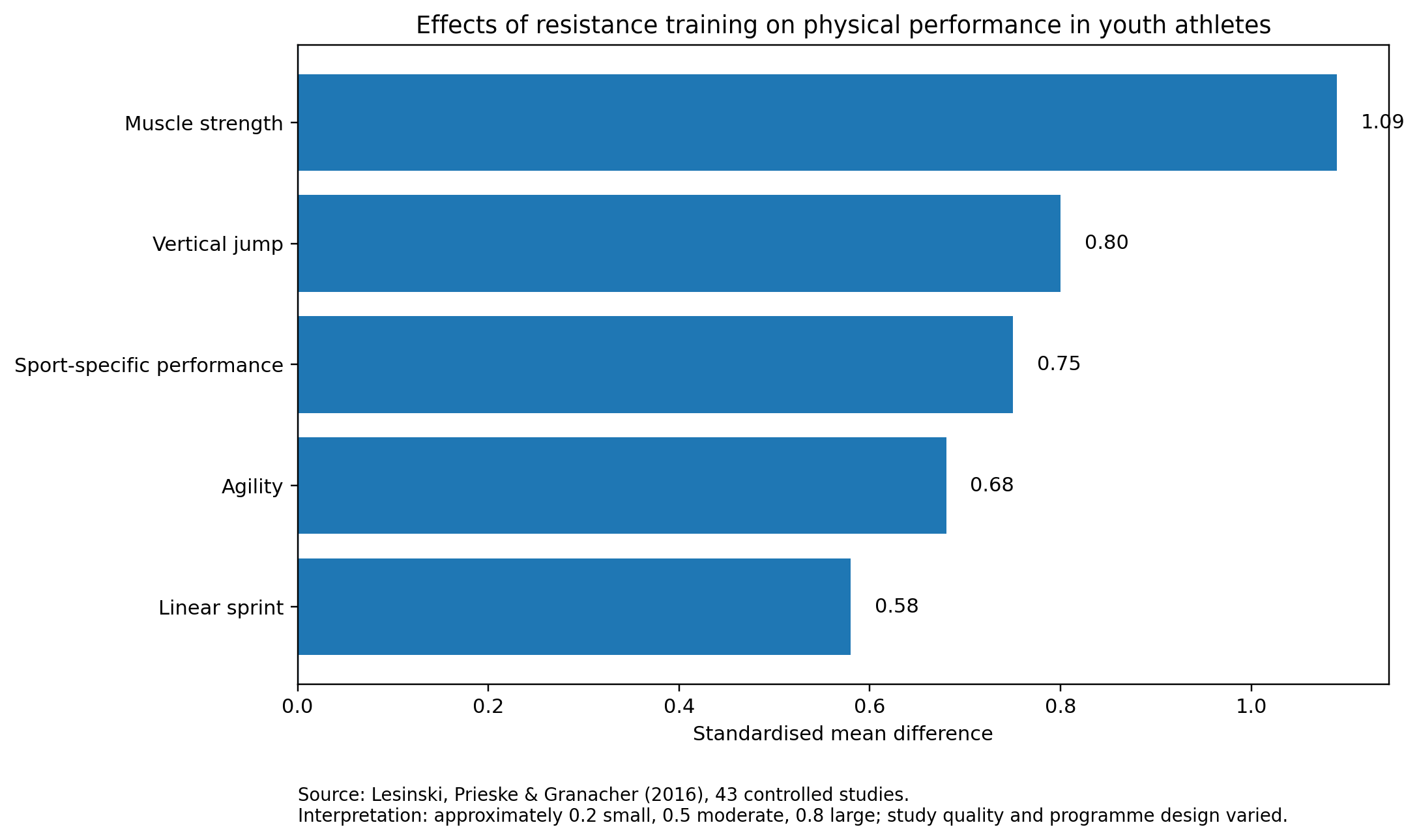
The important point is that those improvements came from developing physical qualities—not from making every exercise look like a sporting skill.
The problem with “sport-specific” gym exercises
Many exercises are labelled sport-specific because they include a ball, bat, racket or movement that resembles the sport.
However, looking similar does not always mean the exercise will transfer effectively.
Adding resistance to a throwing, kicking or swinging action may change the speed and coordination of the skill. At the same time, the resistance may not be heavy enough to create a meaningful strength adaptation.
The exercise can end up being less effective for both skill development and physical development.
A clearer approach is often better:
Practise the sport in the sport environment. Develop physical qualities in the training environment.
For a young athlete, a well-coached squat, sprint, jump or medicine-ball throw may provide far more value than a complicated exercise designed mainly to look impressive on social media.
Does this mean sport-specific training is unnecessary?
No.
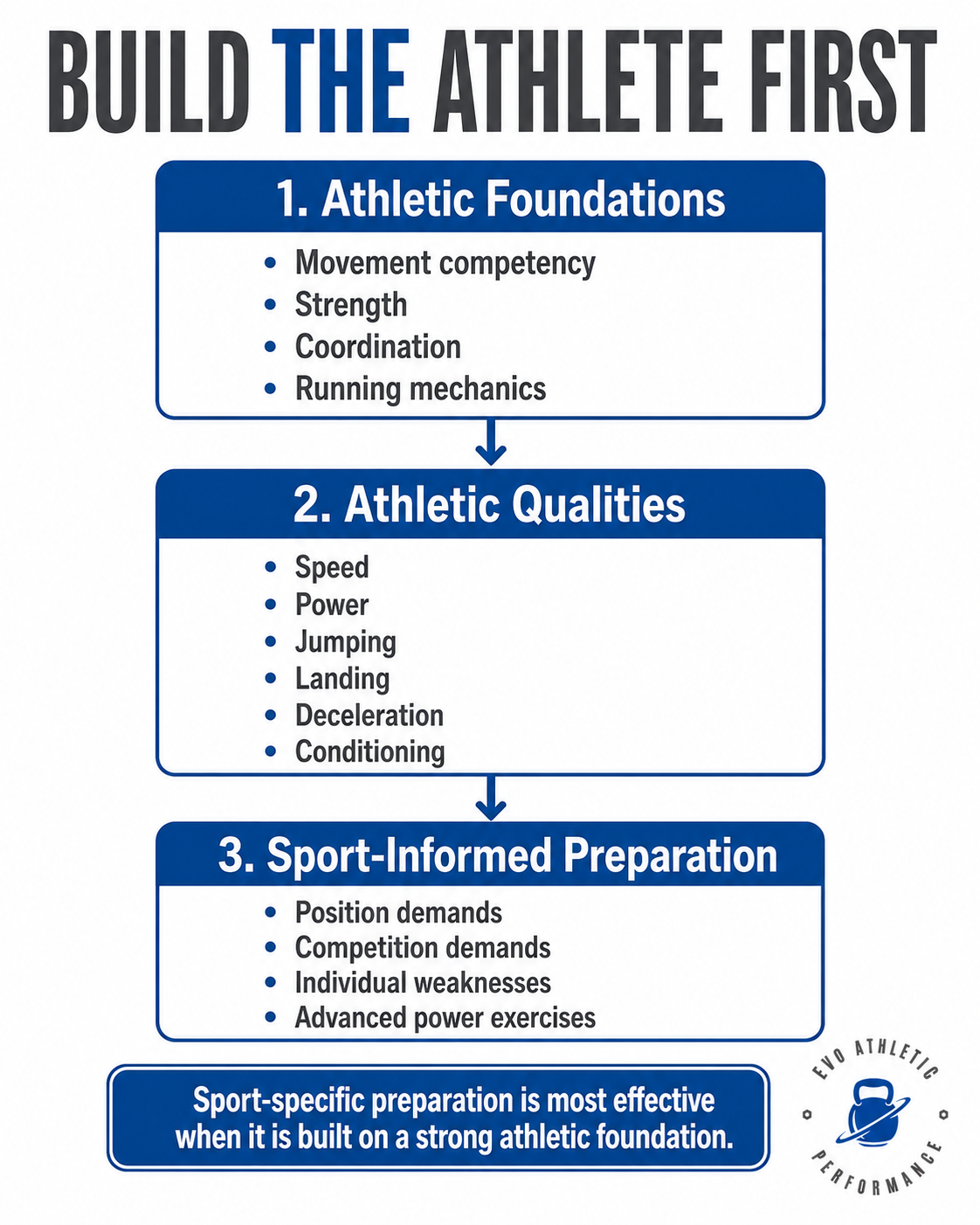
Sport-specific physical preparation becomes more important as an athlete develops.
An experienced basketball athlete may need additional work on repeated jumping, lateral movement and deceleration.
A baseball athlete may benefit from rotational medicine-ball throws and carefully managed upper-body power training.
A rugby league player may require greater emphasis on acceleration, lower-body strength, trunk capacity and contact preparation.
But these exercises should be added to a strong foundation.
They should not replace basic strength, speed, movement and power development.
The more experienced the athlete becomes, the more targeted their training can be. Progression should be based on the athlete’s training history, competency and individual needs, not simply their age or the sport they play.
In other words, don’t do an exercise just because you see a pro athlete doing it or because it looks cool.
What about early sport specialisation?
Sport-specific physical preparation should not be confused with specialising in one sport from a young age.
Early specialisation often involves year-round participation in one sport while reducing involvement in other sports and forms of physical activity.
Research has associated high levels of specialisation and repetitive sporting workloads with an increased risk of overuse injury in young athletes.
This does not mean young athletes must play several organised sports. It does mean that their physical development should include variety.
Running, jumping, landing, throwing, climbing, balancing and learning different movement skills can all contribute to long-term athletic development.
The goal is to create adaptable athletes, not athletes who are only comfortable performing one narrow set of movements.
What should parents look for in a program?
A quality youth athletic development program should:
• Start at the athlete’s current ability level.
• Teach movement skills before adding unnecessary complexity.
• Progress strength and speed training gradually.
• Include jumping, landing and deceleration.
• Account for the athlete’s sport schedule and total workload.
• Modify training according to competency and training experience.
• Use sport-specific exercises only when there is a clear purpose.
The program should not be judged by how advanced or complicated it looks.
It should be judged by whether the athlete is improving.
The main message
Young athletes do not need every exercise to look like their sport.
They need to develop the physical qualities that allow them to perform their sport more effectively.
That means learning to:
Move well. Get stronger. Sprint faster. Jump and land effectively. Produce force. Absorb force.
Sport-specific preparation has an important place.
But for most young athletes, it should be built on top of a broad athletic foundation, not used as a replacement for one.
Build the athlete first
At Evolution Athletic Performance, training is based on the athlete’s ability, training experience and individual needs.
Our programs develop the strength, speed, power and movement qualities that support long-term sporting performance.
Explore our online athletic development programs or enquire about individual coaching and athlete performance testing.
